Emotions as Data: What Your Inner World Is Communicating
Most of us were never really taught how to understand our emotions. We were taught how to manage them instead—how to control them, hide them, push through them, explain them away, stay productive despite them, stay pleasant despite them, stay “fine” despite them.
And over time, many of us learn to function while feeling disconnected from what’s actually happening inside.
Our bodies, our relationships, and our nervous systems often end up carrying what never had space to be fully felt or understood.
For a lot of people, emotional language is limited to a few familiar words—happy, sad, angry, stressed. But underneath that surface, there’s often a much wider, more nuanced emotional world happening that we were never given the tools to name or explore.
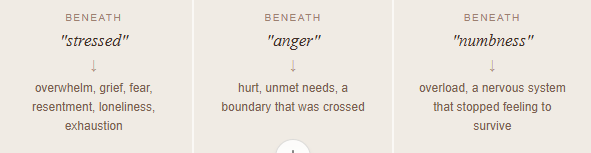
And when emotions go unnamed, they don’t disappear.
They become behaviors.
They show up as:
people-pleasing
overthinking
shutting down
snapping at people we love
perfectionism
avoidance
burnout
hyper-independence
emotional withdrawal
constant busyness
But what if emotions aren’t interruptions to “get over,” but information asking to be understood?
What if emotions are data — not dictators, not identity, not character flaws — but signals? Messages? Information from the mind and body that something deserves attention? On a biological level, emotions are part of the nervous system’s communication process—shaped by brain activity, hormones, and lived experience. They’re not random. They’re responsive.
That does not mean every emotion should control our decisions. But it does mean emotions often carry insight about our boundaries, our needs, our fears, our relationships, our grief, our desires, and our nervous system. And when we begin to see them that way, we stop asking, “How do I get rid of this?”
and start asking, “What is this trying to tell me?”
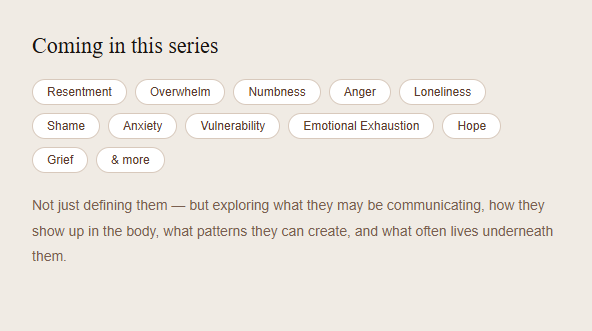
We learn math. History. Performance. Productivity. But many of us were never taught how emotions show up in the body, how they influence behavior, how suppressed emotions impact relationships, how to distinguish fear from intuition, or why rest can feel unsafe for some nervous systems.
This is part of why emotional literacy matters so deeply.
You cannot respond compassionately to an inner experience you do not understand.
This series is for you if you've ever thought:
"Why am I reacting this way?"
"Why do I feel disconnected?"
"Why do I struggle to relax?"
"Why do I shut down, overthink, overgive, or feel emotionally exhausted?"
Or if you simply want a deeper understanding of what's happening beneath the surface — and how that understanding can help you take better care of yourself, your body, and your emotional world.
Maybe healing is not about becoming less emotional. Maybe it is about becoming more understanding of what our emotions have been trying to communicate all along. Maybe your emotions are not the enemy. Maybe they are part of the conversation.
If this resonates with you, I'd love to stay connected. This series will be shared over the coming weeks — exploring emotions, nervous system understanding, and self-connection in a grounded and compassionate way.
Sign up below to receive it directly to your inbox, and come find me on Instagram and Facebook — I'd love to have you there.