Why We Confuse Self-Care With Self-Love
A letter to you — and to the version of me who kept doing all the right things
Dear friend,
I want to tell you about a day that changed something for me — not dramatically, not all at once, but in the quiet, uncomfortable way that real shifts usually happen.
It was one of those days when life was just... lifing. You know the kind. Everything piling up, nothing resolved, and that particular exhaustion that isn't about sleep. I was at my wits' end. And when I finally got a moment to talk about what I was feeling, something strange happened.
I opened my mouth — and I narrated.
I described my feelings like I was reading them off a report. Calm. Coherent. Organized. And completely disconnected from the actual thing happening inside me.
| And the strange part? I had done everything "right" that day. I walked. I journaled. I had my dark chocolate. I did some Qigong. I vented. I hydrated. And checked off a few other boxes on the good ole "self-care" list.
But even in all of it, something felt hollow. Like I had been performing. Curating a version of wellness without ever actually showing up for myself. And here's the part I had to sit with: a few days later, I was dealing with the exact same draining situations. Nothing had actually shifted.
That was the moment I started asking a different question.
Not what can I do to feel better?
But — what is actually going on inside me?
What we tend to do
Most of us were never taught how to stay with ourselves. We were taught to function — to adapt, to perform, to keep moving. We learned to manage emotions long before anyone showed us how to actually be with them.
So when life gets hard, we reach for self-care. And that makes sense. Self-care gives us something to do. It offers structure, relief, a sense that we are at least trying. The walks, affirmations, the journaling, the rituals — these things aren't wrong. Many of them genuinely help regulate us in the moment.
But here's what I noticed in myself: I would do something nice for myself, feel a little better — and then find myself right back in the same draining patterns. Saying yes when everything in me wanted to say no. Overworking when sometimes the most honest thing would have been to let something fall apart. Pouring myself empty trying to fix everyone else's problems, as if my worth depended on it.
The self-care helped me cope, but it didn't help me change.
Why we do it
The reason is quieter than most people expect.
Self-care is safer than self-love. It gives us action without requiring presence. We can soothe ourselves without having to meet ourselves. We can feel productive about our healing without having to look at what actually needs healing.
|We stop asking "what am I actually feeling?" and start defaulting to "what can I do to feel better?" One is a relationship. The other is a transaction.
And if we were never shown how to sit with emotional intensity — if we grew up learning that discomfort was something to fix, not something to feel — then of course we'd reach for the thing that offers relief. Of course we'd learn to narrate our feelings instead of feel them. It's adaptive. It makes complete sense.
But over time, we end up caring for a version of ourselves we are never fully in relationship with.
How we shift
This is where it got real for me — and where I think the actual work lives.
Self-love, I've learned, is less about what you do for yourself and more about the relationship you're willing to have with yourself. And I don't mean knowing yourself on the surface — knowing what you like, what you don't like, what you do for a living, what lights you up on the weekends. I mean knowing yourself deeply.
I mean getting genuinely curious about what lives underneath. Your patterns — the ones that keep showing up no matter how much self-care you do. Your subconscious beliefs — the ones quietly running the show while you're busy doing all the right things. The part of you that keeps saying yes when you mean no, that keeps shrinking to keep the peace, that keeps overextending because somewhere along the way you learned that your worth was tied to how much you could give.
That kind of self-knowledge doesn't come from a bubble bath. It comes from being willing to sit with yourself honestly — not to criticize what you find, but to meet it. With the same curiosity and compassion you'd offer a friend who came to you exhausted and at their limit.
For me, that looked like asking harder questions.
Why do I say yes when I mean no?
What am I afraid will happen if I stop fixing everyone's problems?
What belief is underneath the compulsion to drain myself before I rest?
And then — staying with what came up instead of immediately soothing it away.
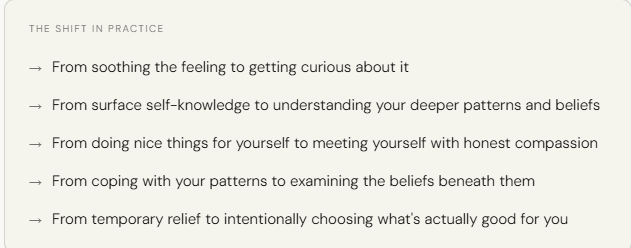
| That presence — meeting yourself, being in relationship with yourself — begins to reveal the beliefs you've been living by without even realizing it. And that awareness creates something self-care alone never could: the ability to intentionally choose differently. Different thoughts. Different responses. Different boundaries. Not just the patterns that feel familiar — but the ones that are actually good for you. Thoughts, actions, behaviors, emotions — chosen on purpose, from a place of knowing yourself.
Self-care will always be a part of it for me. The walks, the Qigong, the dark chocolate — I'm not giving those up.
But now they're something I do from a place of genuine care, not as a substitute for it.
So if you've been doing all the right things and still finding yourself back at the same place — the same exhaustion, the same patterns, the same quiet feeling that something is still off — I want you to know: you're not broken, and you're not doing it wrong.
You may just be ready for the deeper layer.
"You may not need to become better at taking care of yourself. You may need to become willing to really know yourself — and meet what you find there with compassion."
Not perfectly.
Not all at once.
But with the same patience you'd offer anyone you love.
Because self-love isn't a routine you maintain. It's a relationship you keep returning to — especially on the days when life is lifing and all the rituals in the world can't replace the one thing that actually changes things: really being with yourself.
With love,
A fellow traveler of L.I.F.E. — Living In Full Expression